The Modern Man's Search: St. John Vianney on Silence and Rest
Why is the modern man so restless? St. John Vianney saw the same pattern two centuries ago. A 5-minute reflection on comfort, pleasure, and the search for true rest.
PSYCHOLOGY & FAITHWISDOM OF THE SAINTSARTICLES
spwworship
7/16/20262 min read
The Modern Man's Search – St. John Mary Vianney
Part 1: The Silence of Emptiness – A Reflection on the Modern Man's Search
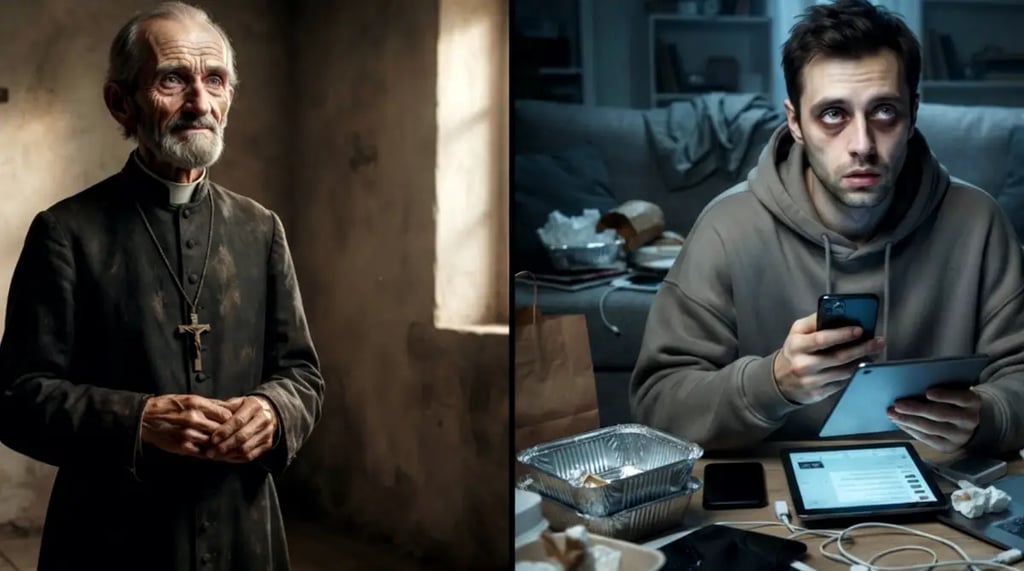
St. John Mary Vianney, the Curé of Ars, did not encounter monsters or hardened criminals in his parish two centuries ago. He encountered ordinary men. Men who, like so many today, were simply tired. They sought legitimate relief from the pressures of a life that demands so much, and this search, in its origin, was entirely reasonable. The problem, Vianney observed, was not the desire for rest, but the path chosen to achieve it.
What happens to the man who organizes his routine around comfort is a silent erosion. Without realizing it, he begins to trade reality for a constant dose of immediate gratification. Rest, which should be fuel for living, becomes a refuge from living. The man becomes incapable of being present in simple moments, incapable of tolerating silence, incapable of facing any discomfort, however small.
The tragedy that Vianney described is not that of a man who gave up being happy, but of a man who is being emptied. He consumes pleasures in the hope of finding rest, but that rest never comes, because immediate pleasure was not made to deliver it. In the end, what remains is the feeling that something essential has been subtracted from his life: the ability to sustain reality, to have deep conversations, to pray with focus, or simply to exist without the need for constant distraction. The great paradox is that, in trying to flee effort, man ends up losing the very joy he was seeking.
Part 2: Inside the Mind – An Analysis of Psychological Nuances
To understand the phenomenon observed by Vianney under a psychological light, we can see it not as a moral judgment, but as a failure in the "management of desire" and in our capacity to tolerate frustration.
Here are the key points of this dynamic:
The Confusion Between Relief and Rest: The human brain seeks pleasure as a quick way to lower tension. The problem is that "relief" (immediate pleasure) is a temporary solution, while "rest" (what the soul truly seeks) requires depth and time. When we confuse the two, we create a feedback loop: we seek pleasure to escape anguish, but because pleasure does not fill the existential void, the anguish returns, demanding more pleasure.
The Atrophy of Emotional "Muscle": The constant search for comfort works as a sedative for our capacity to cope. The more we avoid effort or discomfort, the less prepared we become to deal with reality. It is like a muscle that, without exercise, withers; our ability to be present and focused on something that requires effort becomes "anhedonic" — we lose the ability to feel pleasure in life itself, depending only on external stimuli.
The "Consumption" of One's Own Time: There is a fundamental difference between being an agent of one's own history and being a consumer of one's own life. When a man organizes his life to avoid discomfort, he stops making decisions and becomes driven by his impulses. The result is a state of constant restlessness, where the mind never rests because it is always searching for the next object of satisfaction.
The Path to Recovery: The key to breaking out of this cycle, according to Vianney's observations, is not pure and simple deprivation, but reorientation. It is about recovering the capacity to "wait" and to "tolerate" discomfort. When a man learns to sit with his difficulties, rather than flee from them, he stops consuming substitutes and finally begins to find the real satisfaction that, ironically, was always available but ignored.
Connect
Join our community for uplifting worship content
Contact
Subscribe
apocrifo1815@gmail.com
© 2026. All rights reserved.