Who Are You When the Screen Turns Off? | Catholic Youth
Your likes, posts, and filters aren’t your soul. A fresh, honest look at digital identity vs. real identity for Catholic youth. 4-minute read.
CATHOLIC YOUTH
SPWWORSHIP
5/22/20262 min read
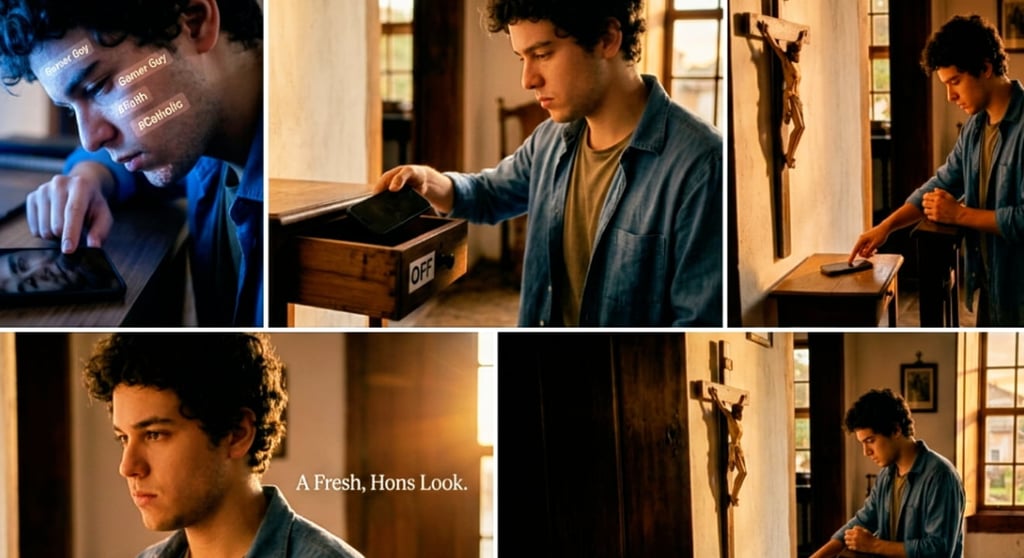

Who Are You When the Screen Turns Off?
You have a perfectly curated feed. A highlight reel of laughter, sunsets, and witty captions. You know exactly which filter makes you look “effortless.” And when the likes come in, for a moment, you feel seen.
Then you put the phone down. The screen goes black. And in the silence, a quiet question rises from somewhere deep inside:
“Who am I when no one is watching?”
If that question makes you uncomfortable, good. It means your soul is still alive.
The Digital Self: A Mask or a Mirror?
Social media is not evil. It’s a tool. But like any tool, it can either build a cathedral or dig a grave. The problem begins when we mistake our online persona for our eternal soul.
Think about it:
On Instagram, you are a brand.
On TikTok, you are an algorithm.
On Snapchat, you are a disappearing story.
But in the eyes of God, you are a beloved son or daughter, chosen before the foundation of the world (Ephesians 1:4). That identity does not change with engagement rates.
Saint John Paul II taught us that we become what we love. So ask yourself honestly: What am I loving when I scroll? Am I loving attention? Comparison? The dopamine hit of a notification? Or am I loving truth, beauty, and the face of Christ?
The Split That Wounds Your Soul
Psychologists call it the “online disinhibition effect” — the tendency to say and do things online that you would never do in person. But there is a deeper wound: identity fragmentation.
You become one person in your group chat, another in your comments section, another in your private search history. And slowly, you lose the ability to be one person — the person God made.
Jesus prayed for this exact thing: “That they may be one, as we are one” (John 17:11). That unity begins inside you. Your online self and your offline self must become the same person: truthful, kind, and chaste.
Three Questions Before You Post
Before you hit “share” today, stop. Breathe. Ask yourself these three questions — they come straight from the Catholic moral tradition, but they cut through the noise:
Is it true? Not just factual — but does it reflect who I really am? Or is it a performance?
Is it loving? Would I say this to someone’s face, looking into their eyes?
Does it lead me closer to Christ? Or does it feed my pride, envy, or loneliness?
If you can’t answer “yes” to all three, save it for confession — not for the cloud.
The Screen Goes Dark — But You Remain
Here is the most liberating truth you will ever hear: You are not your content.
When the screen turns off, you are still there. Your baptism is still there. Your guardian angel is still there. The Eucharistic Lord, waiting for you in the tabernacle, is still there. None of that depends on Wi-Fi.
The world wants you to be a ghost — visible but not real. God wants you to be a saint: fully yourself, fully loved, fully alive.
So tonight, before you sleep, try something radical. Turn off your phone for ten minutes. Sit in silence. And whisper:
“Lord, who am I? Not my followers, not my filters. Just me. Tell me again.”
And He will answer. Not with a notification. But with peace.
A Challenge for This Week
Pick one day — just one — where you do not post anything. Scroll if you must, but do not perform. Let your presence online be silent. Then notice what rises in your heart. That rising is your real identity, asking to be seen by the only eyes that matter.
Connect
Join our community for uplifting worship content
Contact
Subscribe
apocrifo1815@gmail.com
© 2026. All rights reserved.