Daily Word: John 15:9-17 Reflection – Thursday, May 14 | Feast of St. Matthias
Jesus calls us friends and gives us a new commandment: love that lays down its life. On this feast of St. Matthias, discover how to live this divine friendship.
DAILY WORD
5/13/20264 min read
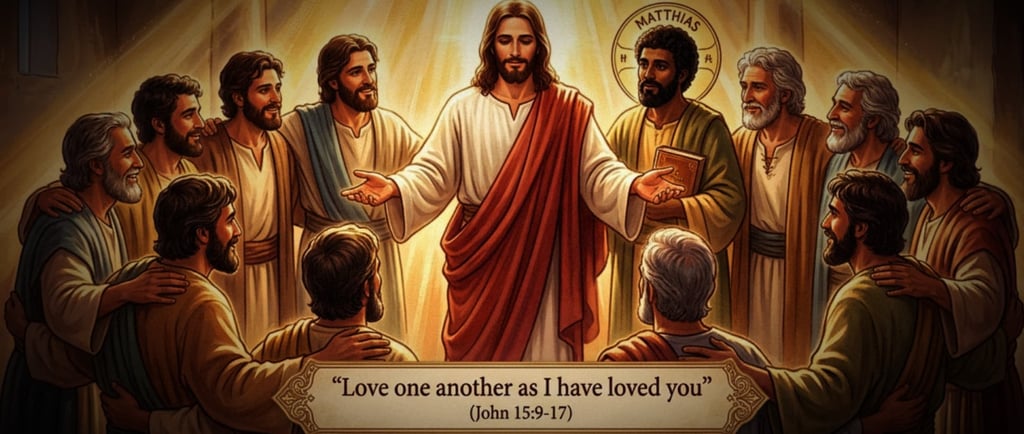
📖 Holy Gospel According to John 15:9-17
Jesus said to his disciples:
9 “As the Father has loved me, so have I loved you. Now remain in my love.
10 If you keep my commands, you will remain in my love, just as I have kept my Father’s commands and remain in his love.
11 I have told you this so that my joy may be in you and that your joy may be complete.
12 My command is this: Love each other as I have loved you.
13 Greater love has no one than this: to lay down one’s life for one’s friends.
14 You are my friends if you do what I command.
15 I no longer call you servants, because a servant does not know his master’s business. Instead, I have called you friends, for everything that I learned from my Father I have made known to you.
16 You did not choose me, but I chose you and appointed you so that you might go and bear fruit—fruit that will last—and so that whatever you ask in my name the Father will give you.
17 This is my command: Love each other.”
🌿 Reflection: The Joy of Divine Friendship
Opening question:
Have you ever stopped to consider what it truly means to be called a “friend” by God?
(Pause and reflect.)
1. The Initiative of Love: He Chose Us First
Jesus is emphatic: “You did not choose me, but I chose you” (John 15:16). This is the great revolution of Christianity: it is not we who, by our own merits, reach God; it is He who, by pure grace, calls us. Friendship with Christ begins in this unsettling truth.
Question: How often do we live our faith as if it were an achievement, when in reality it is a gift?
St. Thomas Aquinas teaches that “every friendship is an election” – a deliberate choice of whom we want close. God chose us before we were born, and this divine election is the foundation of our dignity.
Key lessons:
The initiative belongs to God, not to us.
Our response must be humble and grateful.
We are loved not by merit, but by grace.
2. Radical Newness: Servants or Friends?
“I no longer call you servants, because a servant does not know his master’s business. Instead, I have called you friends, for everything that I learned from my Father I have made known to you” (John 15:15).
Jesus does not want us as mere executors of orders, but as confidants who share in his intimacy. The servant acts out of fear or obligation; the friend acts out of love and knowledge. The Son of God is no longer just Master; He is a true friend.
He hides nothing from us: “he made known everything he heard from the Father.” If God hides nothing from us, why do we continue to live as if we were in the dark?
3. The Commandment That Summarizes All Others: Love to the End
“My command is this: Love each other as I have loved you” (John 15:12).
This is not a poetic or fleeting love. It is the love that Jesus lived: gratuitous, generous, even to the total gift of life. Note: Jesus does not ask the impossible. He loves us exactly as the Father loved him (John 15:9).
Metaphor:
Jesus’ love is like a fire that never goes out: once kindled in the heart, it must be fed by obedience and sharing. Whoever does not love lets the fire die; whoever loves spreads the flame, illuminating and warming everyone around.
4. St. Matthias: The Faithful Friend Who Took the Vacant Place
Today we celebrate the Feast of St. Matthias, the apostle chosen to replace Judas. His name, Matthias, means “gift of God.” Matthias was chosen by lot from among the disciples who had accompanied Jesus from his baptism until his ascension. Tradition tells us he evangelized Judea, Cappadocia, and Ethiopia, where he was martyred – stoned and then beheaded.
The choice of Matthias by lot – a well-known method in Sacred Scripture for discerning God’s will – teaches us that we are not chosen by chance. Matthias was there, available, faithful. This means that there is always a place for those who truly love. Judas fell, but the college of the Twelve did not remain incomplete. God always has a replacement for the traitor and an opportunity for the one who remains faithful.
Matthias teaches us that true friendship with Christ is made of witness. He was chosen precisely because he could testify to the Lord’s resurrection.
5. Fruit That Will Last
“I appointed you so that you might go and bear fruit—fruit that will last” (John 15:16).
Friendship with Christ is not given for our own consumption, but for mission. The true fruit that lasts is love lived out in the Church and in the world. The full joy Jesus speaks of (John 15:11) is not the superficial joy of those who have no problems, but the deep joy of knowing that we are loved and that, by loving, we make a difference.
Questions to reflect on:
What fruit have I been producing in my community?
Has my witness attracted anyone closer to Jesus?
What can I do today so that the “fruit” of my faith is not lost?
✨ Conclusion: To Remain in Love Is Our Mission
On this feast of St. Matthias the Apostle, Jesus invites us to a radical choice: to remain in his love. Remaining is not a passive state, but an active remaining: keeping the commandments, loving our brothers and sisters, producing fruit that endures.
May the intercession of St. Matthias help us respond to this divine friendship, giving our lives – not necessarily a bloody martyrdom, but the daily martyrdom of charity, patience, and forgiveness.
📿 Prayer
O God, who by the election of St. Matthias added a new member to the apostolic college, grant us, through his intercession, that we too may always be faithful to our calling, producing fruits of love and holiness. Through Christ our Lord. Amen.
Connect
Join our community for uplifting worship content
Contact
Subscribe
apocrifo1815@gmail.com
© 2026. All rights reserved.