Our Lady of Caravaggio: When Heaven Meets a Broken Heart
A violent husband, a weeping mother, and an apparition that changed history. Discover the profound message of Our Lady of Caravaggio (1432) for your life today.
ARTICLESWISDOM OF THE SAINTS
SPWWORSHIP
5/23/20265 min read
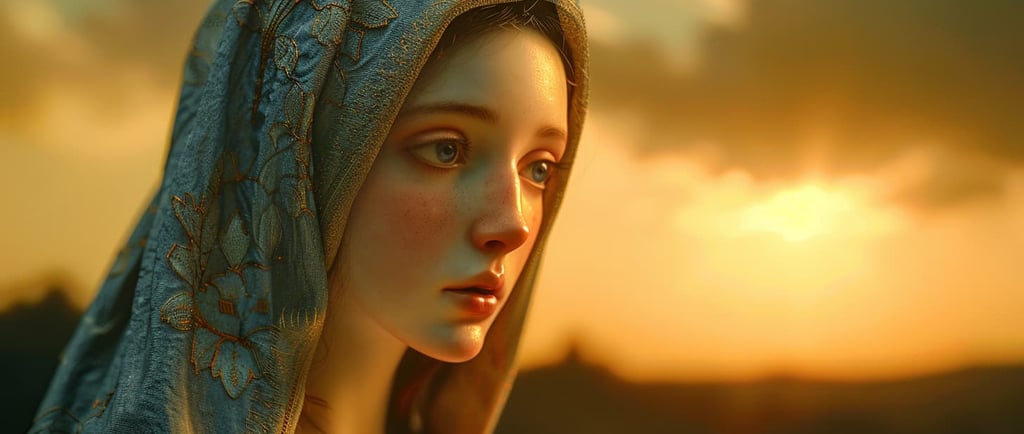
Introduction: The Human and Psychological Hook – The Profile of Giannetta
Her name was Giannetta Vacchi. She was thirty-two years old. And by the morning of May 22, 1432, her soul resembled a field trampled by armies — exhausted, bleeding, and left for dead.
She was not a nun. Not a mystic. Not a noblewoman. She was a contadina — a peasant woman from the countryside near Caravaggio, in northern Italy. Her daily life was a quiet war: rising before dawn, tending livestock, drawing water, grinding grain. But her real battle was not with the soil.
It was with her husband.
Historical records, preserved by the Church after the apparition, describe a marriage marked by violence, contempt, and emotional torment. Giannetta lived under the shadow of a man who treated her not as a wife but as property. She had no legal recourse. No shelter. No therapist. In the language of classical psychology, she was trapped in a cycle of abuse — her psyche fragmented by chronic fear, her dignity buried under layers of shame.
On that May morning, she walked to a field to collect grass for her animals. She was exhausted, not only from labor but from the slow suffocation of a life without hope. And then — without warning — Heaven broke through.
The Céu does not despise a broken heart. It descends into it.
Historical Context: The Collective Pain of a Divided Land
Giannetta’s personal suffering was mirrored by the land around her. In 1432, the region of Caravaggio was a chessboard of blood.
The Duchy of Milan and the Republic of Venice had been fighting for decades. Mercenary armies — condottieri — burned villages, destroyed crops, and raped women with impunity. Famine was common. Men were conscripted or killed. The poor, especially women, paid the highest price.
Into this hellscape of political ambition and human misery, the Virgin Mary appeared. But she did not appear to a pope or a prince. She appeared to a beaten peasant woman.
This is the scandal of Catholic spirituality: God consistently bypasses the powerful and chooses the powerless as His messengers. Mary, who once sang the Magnificat about casting down the mighty and lifting the lowly, was staying true to her song.
What did she say to Giannetta? Not a complex theological treatise. She said, in essence: “Go. Tell my Son’s people to stop sinning. Tell them to fast on Fridays and Saturdays in honor of My Son and Me. Tell them to make peace.”
Historians later called Mary the “Diplomat of Heaven.” At a time when human diplomats were failing, the Queen of Peace stepped in. Her message was not political strategy — it was conversion. Because, as she knew, peace treaties written on paper mean nothing if hearts remain prisons of hatred.
Today, our world is also polarized. Families are divided by ideologies, nations by tribes, hearts by unforgiveness. Caravaggio reminds us: personal repentance is the only true foundation for social peace.
Theological Meaning: The Symbols Hidden in the Revelation
The Spring of Living Water
When Mary appeared, she stood on a dry patch of earth. But after she spoke, she stepped aside — and where her foot had touched, a spring of fresh water burst forth. That spring flows to this day.
Theologically, this is a direct echo of Exodus 17, where Moses struck the rock and water gushed out for a thirsty Israel. But here, the “rock” is the soil of a suffering woman’s life. And the water is grace.
In the Gospel of John, Jesus tells the Samaritan woman at the well: “Whoever drinks the water I give will never thirst” (John 4:14). Mary, at Caravaggio, becomes the instrument of that living water — a symbol of Baptism, of purification, of the Holy Spirit who heals the parched soul.
Psychologically, consider this: Giannetta’s daily life was dry — dry of affection, dry of safety, dry of hope. The spring represents the sudden, irruptive gift of emotional and spiritual renewal. It is as if Mary said: “Your tears have not been wasted. See? They have become a fountain.”
Christocentricity: Mary Always Points to Her Son
Unlike some apparitions that focus on Mary alone, Caravaggio is profoundly Christ-centered. Mary’s message was urgent: the people had offended God by blasphemy, by breaking Sundays and holy days, by living in enmity. She said that God the Father was justly angry — but that she, as Mother, was interceding to turn away His wrath.
This reveals two truths:
The reality of divine justice. Sin matters. It wounds the sinner and offends God. Modern sensibilities often reduce God to a tolerant grandfather. Caravaggio restores the biblical tension: God is love, but love that rejects evil.
The power of Marian intercession. Mary does not compete with Christ. She stands with Him, as she stood at the Cross. Her role is Consolatrix Afflictorum — Consoler of the Afflicted — and Advocata — Advocate who presents our tears to the Son.
In psychological terms, Mary functions as the “good enough mother” who holds the traumatized child (Giannetta, and us) and carries us to the Father. She does not replace healing; she facilitates it.
Salvific Meaning and Practical Teachings for Today’s Faith Life
The Call to Fasting: Beyond Food
Mary asked for fasting on Fridays (in honor of Christ’s Passion) and Saturdays (in honor of her own sorrows). For 15th-century peasants, fasting meant bread and water. For us?
The spirit of Caravaggio calls us to fast from more than food:
Fast from scrolling — give your attention to God and family.
Fast from harsh words — speak only what builds up.
Fast from resentment — forgive the one who has hurt you, even if they don’t ask.
Fast from the need to be right — choose peace over victory.
Why? Because fasting is not self-punishment. It is reordering our loves. When we say “no” to a lesser good, we create space for the Highest Good.
The Sanctification of Everyday Life
Giannetta was not in a chapel. She was working. She was collecting grass — a mundane, repetitive, humble task. And there, in the ordinary, the extraordinary appeared.
This is the great lesson of Caravaggio: Holiness is not an escape from daily duty. It is the transformation of duty into encounter.
You do not need to flee to a monastery to meet Mary. She comes to you at the kitchen sink, in the carpool line, in the hospital waiting room, at your desk. Your weariness is not an obstacle to grace — it is often the very condition for it.
Psychologically, this is crucial. Many people suffer from a “spiritual split” — believing that God is only present in sacred places and times. Caravaggio heals that split. The sacred and the secular are not enemies. The secular is where the sacred hides, waiting to be found.
Conclusion: From Trauma to Mission
What happened to Giannetta after the apparition?
She obeyed. She ran to the local priest. She told him everything. The priest, skeptical at first, went to the field. He saw the spring. He investigated her story. Within weeks, thousands flocked to the site. The Bishop of Cremona declared the apparition authentic. A sanctuary was built. And the violence in the region — though not ending overnight — began to soften. Families reconciled. Soldiers laid down arms.
But what about Giannetta’s marriage? History is silent on the details. We do not know if her husband changed. What we do know is this: Giannetta was no longer a victim. She had been visited by Heaven. Her dignity was restored. She had a mission: to tell others about mercy.
And that is the final truth of Caravaggio.
You may be living your own hidden Calvary — an abusive relationship, a chronic illness, a betrayal that won’t stop bleeding. Mary does not promise to remove your suffering instantly. But she promises to stand with you in it, to turn your dry ground into a spring, and to send you back into the world as a witness — not of your pain, but of His peace.
Our Lady of Caravaggio, Consoler of the Afflicted, pray for us.
A short prayer after reading:
Mother of Caravaggio, you saw a woman no one else saw. Look upon me now, in my hidden exhaustion. Let your footprint become a spring in my dry heart. Teach me to fast from what harms me, to work with holiness, and to trust that even in my ordinary field, Heaven is near. Lead me to your Son, who alone gives peace. Amen.
Connect
Join our community for uplifting worship content
Contact
Subscribe
apocrifo1815@gmail.com
© 2026. All rights reserved.