Psychology & Faith: Understanding Depression – A Catholic Guide to Mental Health
Depression is not a sin. Learn how Catholic teaching and psychology work together to heal the mind, body, and soul. Discover the harmony of faith and therapy.
PSYCHOLOGY & FAITH
SPWWORSHIP
5/15/20263 min read
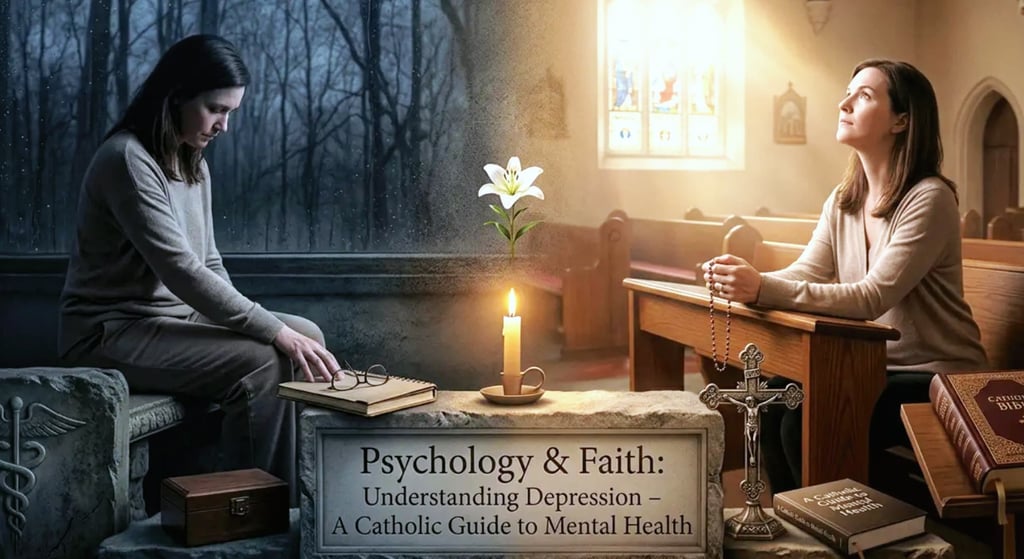
📖 Article: When the Soul Hurts – Understanding Depression Through the Lens of Faith
🕯️ Introduction: A Silence That Speaks
Every Sunday, millions of Catholics sit in pews, sing hymns, receive the Eucharist – and feel nothing. Not sadness, not anger. Just emptiness.
For years, many were told: “Pray more. Go to confession. It’s just a spiritual attack.”
But what if the silence isn’t a lack of faith? What if it’s a chemical imbalance? What if the soul hurts because the brain is sick?
The Church has an answer: grace perfects nature, it does not destroy it (St. Thomas Aquinas).
🧠 1. The Myth of “Only Spiritual”
Let’s be clear: Depression is not a sin. Anxiety is not a demon possession. Intrusive thoughts are not mortal faults.
Yes, the enemy can exploit mental fragility. But not every dark night is a dark night of the soul (St. John of the Cross). Sometimes, it’s simply clinical depression – a medical condition affecting neurotransmitters like serotonin and dopamine.
Catechism of the Catholic Church (CCC 2281): “Everyone is obliged to care for their own health.” That includes mental health.
Question for reflection:
If you broke your leg, would you only pray – or would you also see a doctor? Why treat the brain differently?
⚖️ 2. The Twofold Battle: Biology and Spirituality
Catholic psychology acknowledges a double dimension to emotional suffering:
Biological/MedicalSpiritual/MoralChemical imbalancesUnconfessed mortal sinHormonal disordersSpiritual dryness (passive purification)Genetic predispositionAttachment to sinful habitsTrauma-induced PTSDLack of prayer or sacraments
Key insight:
The same symptom (e.g., lack of joy) can have different roots. Discernment is essential.
A faithful Catholic with major depression may feel zero consolation – not because she’s in mortal sin, but because her prefrontal cortex is underactive. Conversely, someone living in unrepentant adultery may feel perfectly happy – false peace.
So what’s the solution?
Never assume. Seek both: a good confessor and a good Catholic psychologist.
🌿 3. Saints Who Knew Darkness
You are not alone. Some of the holiest souls suffered terribly:
St. Thérèse of Lisieux – on her deathbed, she experienced such violent temptations against faith that she said: “If I only believed what I am tempted to believe, I would have killed myself long ago.” (That’s clinical depression + spiritual assault.)
St. Ignatius of Loyola – after his conversion, he fell into deep scrupulosity and despair. A mystical experience healed him, but not before he considered suicide.
Mother Teresa – for nearly 50 years, she lived in profound interior darkness, feeling abandoned by God. She kept serving. That’s not depression – that’s passive purification. But the symptoms looked similar.
Takeaway:
Holiness is not the absence of mental pain. Holiness is perseverance in spite of it.
🛠️ 4. Practical Steps for Integration
If you or someone you love suffers emotionally, here’s a Catholic roadmap:
First – Rule out medical causes.
See a psychiatrist (medication is not anti-faith; it can be a grace).
Get blood work (thyroid, vitamin deficiencies).
Second – Seek spiritual direction.
A good priest can discern if it’s sin, temptation, or purification.
Third – Find a Catholic therapist.
Look for professionals trained in both psychology and Catholic anthropology (soul-body unity). Organizations like the Catholic Psychotherapy Association can help.
Fourth – Never abandon the sacraments.
Even if you feel nothing, go to Mass. Receive Communion. Go to confession monthly. Grace works ex opere operato (by the very act), regardless of feelings.
Fifth – Build a rule of life.
Prayer, sleep, exercise, healthy eating, community, purpose. These are not optional – they are natural supports for grace.
✝️ 5. A Word for Those Who Suffer
Dear brother, dear sister reading this:
Your depression does not make you a bad Catholic. Your anxiety is not a punishment. Your intrusive thoughts are not blasphemies – they are symptoms.
The God who knit you in your mother’s womb (Psalm 139) also knit your brain. He knows your neurotransmitters. He is not offended by Prozac. He is not threatened by therapy.
Go. Get help. Take the medication. Sit in the therapist’s office. And also pray.
Grace works through nature. The same God who healed the blind man with mud and spit can heal you through a prescription pad.
🙏 Prayer for Those Struggling
Lord Jesus, you wept at the tomb of Lazarus. You felt agony in Gethsemane. You cried out, “My God, why have you forsaken me?” You know our pain.
Send your Holy Spirit to guide us to wise doctors, compassionate therapists, and understanding confessors. Give us the courage to seek help. And remind us every morning: our brokenness is not our identity – we are your beloved children.
In your mercy, heal what is biological, strengthen what is spiritual, and turn our silence into a song of trust.
Amen.
Connect
Join our community for uplifting worship content
Contact
Subscribe
apocrifo1815@gmail.com
© 2026. All rights reserved.