The Mystery of the Two Selves: Psychoanalysis and the Saints on Impulsivity
Why do we act against our own good intentions? Freud, St. Augustine, and St. Paul explain the inner war — and the path to integration. 5-minute read.
PSYCHOLOGY & FAITH
SPWWORSHIP
6/2/20264 min read

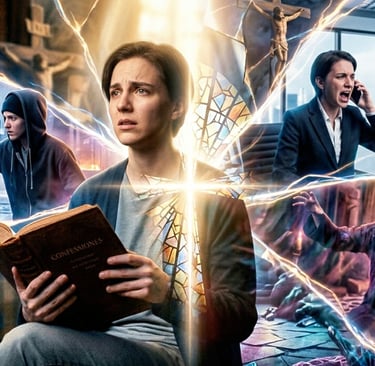
The Mystery of the Two Selves: Psychoanalysis and the Saints on Impulsivity
The Mystery of the Two Selves: Psychoanalysis and the Saints on ImpulsivityWho among us has never experienced the drama of making a calm, rational decision — only to act, hours later, in the complete opposite direction under the weight of a blind impulse? In those moments, we feel inhabited by “two selves”: the rational man who plans the good, and a mysterious inner force that seems to drag us against our own will.
This conflict is not an illusion. It lies at the heart of both the greatest discoveries of psychoanalysis and the deepest mystical theology of the saints and sages of the Church. To understand who truly decides when we fall, we must cross the frontier between the science of the mind and the life of the spirit.
The Ego and the Illusion of Rational Control
In our daily routine, we tend to believe that when we make a conscious, logical decision, we are absolute masters of the situation. Psychoanalysis raises a red flag to this certainty. Sigmund Freud revolutionized the understanding of the mind by demonstrating that the Ego (our organized consciousness) is not master in its own house. Many of our supposedly rational choices are, in fact, justifications we create to mask unconscious desires.
Spiritually, the saints always knew this. They called this false sense of absolute control pride or the illusion of the “false self.” St. John of the Cross and St. Teresa of Ávila explained that the human soul is a vast castle filled with secret mansions; thinking we know ourselves completely and control everything that happens within us is the first step toward a fall.
The Inner Pressure: The Id and Concupiscence
When we act on pure impulse, in a rationally foggy state, psychoanalysis points to the irruption of the Id — the reservoir of repressed, instinctual drives. The Id seeks immediate tension release, operating on the pleasure principle, ignoring long-term consequences.
Catholic theology gives a profound name to this inner force that pressures us: concupiscence. As a consequence of Original Sin, our nature suffered a wound of disorder. The intellect, the will, and the passions lost their original harmony.
The psychological diagnosis of impulsivity finds perfect echo in the dramatic words of St. Paul in his Letter to the Romans:
“For I do not do the good I want, but the evil I do not want is what I keep on doing. […] So I find it to be a law that when I want to do right, evil lies close at hand.” (Romans 7:19-21)
St. Paul describes exactly this sensation of “two selves” that you experience: the law of the mind (the desire for good) in constant war against the law of the members (disordered impulse).
The Psychology of the Saints: St. Augustine and the Divided Will
No saint dissected the psychology of impulsivity and inner division with such precision as St. Augustine in his Confessions. He understood that the human being is not a single, homogeneous block. Augustine narrates the period when he desired conversion but was held back by old habits:
“I was stuck in the mud… Two wills of mine were fighting within me: one old, one new; one carnal, one spiritual; and their conflict tore my soul apart.”
For Augustine, impulsive decision-making occurs when our will is fragmented and weakened by habit. The “second self” that drives us is not an external demon or a second personality — it is our own wounded, addicted freedom, seeking immediate satisfaction in created things rather than resting in God.
The Path of Integration: Grace and Nature
How do faith and depth psychology view the solution to this conflict? The answer lies in the maxim of St. Thomas Aquinas:
“Grace does not destroy nature but perfects it.”
Psychoanalysis proposes that the goal of maturity is not to silence or destroy the impulsive side (the Id) but to integrate it — bringing the unconscious into the light of consciousness (“Where Id was, there Ego shall become”).
In the life of faith, the process is analogous and elevated. The saints teach that we should not simply “crush” our passions and impulses, for they contain the vital energy and deep desire that God gave us. The secret lies in what St. Augustine called the Ordo Amoris (the Ordering of Love). Prayer, the sacraments, and asceticism do not numb us — they reorder our impulses under the light of the Holy Spirit.
Conclusion: A Merciful Gaze Upon Yourself
Understanding that we are inhabited by this psychic and spiritual division frees us from two dangerous extremes: the pride of believing ourselves infallible, and the despair of believing ourselves irredeemable.
When you catch yourself acting on an irrational impulse, instead of condemning yourself or pretending nothing happened, practice the exercise that the desert sages recommended:
Retire within, examine the inner pressure that generated the act, acknowledge the fragility of your nature, and present that fracture to Divine Grace.
It is in the recognition that we are divided that we truly begin to be healed and unified.
A Short Prayer for Integration
Lord Jesus, You who were tempted in every way but remained one with the Father, have mercy on my divided heart. Heal the war between my intentions and my impulses. Let Your grace not destroy my nature but perfect it. Give me the honesty of St. Augustine, the courage of St. Paul, and the trust of St. Thérèse. Unite my two selves into one — a child who loves You, not only in thought but in every action. Amen.
Connect
Join our community for uplifting worship content
Contact
Subscribe
apocrifo1815@gmail.com
© 2026. All rights reserved.